Ranks
How the banzuke ranks wrestlers
The banzuke is the printed ranking sheet of professional sumo. How it is read, who sits at the top, and how a wrestler moves up or down the page.
Book the sumo show ↗Quick answer
The banzuke is the document that lists every professional sumo wrestler in rank order, published before each tournament. East is printed on the right and West on the left, the top wrestlers appear in the largest characters and the lower divisions in smaller ones. Rank rises with a majority of wins and falls with a majority of losses. A sumo show does not use a banzuke, but the hierarchy explains what the host and the wrestlers mention.
What the banzuke is
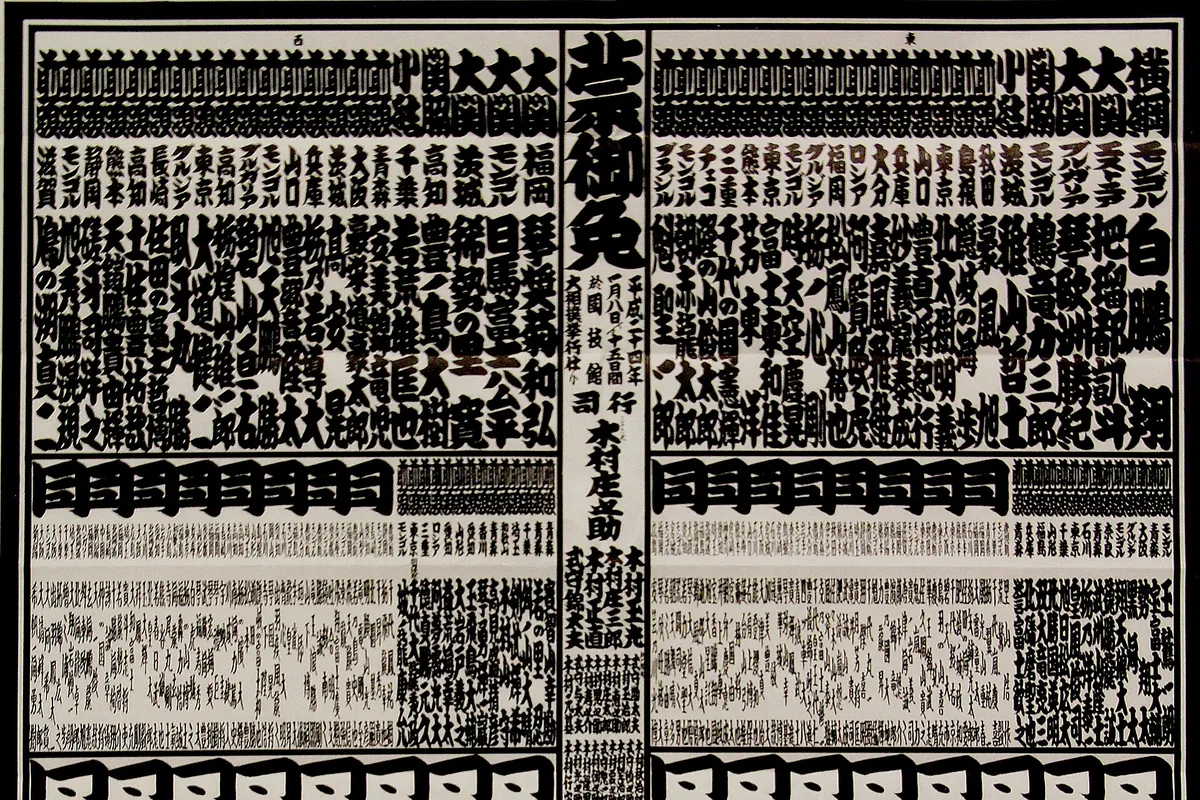
Wikipedia describes the banzuke as a document listing sumo wrestlers' rankings, published before each tournament. It is normally released about two weeks before the tournament begins. Each entry shows the wrestler's ring name, the shikona, with his hometown and rank. The top-ranked wrestlers of the makuuchi division appear at the top in the largest characters, with lower divisions in smaller ones, so the page itself is a picture of the hierarchy. Wikipedia says the form and production of the document can be traced back to 1761.
How to read it
The sheet is read right to left and top to bottom. Wrestlers are split into East, printed on the right, and West, printed on the left. Referees copy the rankings onto a paper roll using a style that Wikipedia calls sumo moji. Because the characters are so dense, the sheet looks like a solid block until you know what to look for. Start at the centre column, where the highest ranks sit, and work outwards.
The six divisions
Professional sumo has six divisions, from top to bottom: makuuchi, jūryō, makushita, sandanme, jonidan and jonokuchi, says Wikipedia. It gives a maximum of 42 wrestlers in makuuchi and fixes jūryō at 28, makushita at 120 and sandanme at 180. Wrestlers in jūryō and above are called sekitori, a word the glossary renders as having taken the barrier. They are the ones who perform the ring-entering ceremony and wear silk belts in tournaments.
The ranks inside makuuchi
Within makuuchi the champion ranks, in descending order, are yokozuna, ōzeki, sekiwake and komusubi, according to Wikipedia. The Japan Sumo Association's tournament pages show the same labels with maegashira beneath them. Promotion to yokozuna is strict: an ōzeki generally has to win the championship in two consecutive tournaments or deliver an equivalent performance. That is why a yokozuna's name carries so much weight when a host mentions one, even in a staged show.
How rank moves
An assembly of 20 sumo judges and three supervisors meets a few days after each tournament and ranks more than 600 wrestlers across six divisions, says Wikipedia. The general rule is that a wrestler with a majority of wins, a kachi-koshi, is raised, and one with a majority of losses, a make-koshi, is lowered. The same article notes there are no precise rules, so the committee has room for judgement. The results of a 15-day tournament feed directly into that decision.
What this means at a show
A sumo show has no banzuke and no promotion. The booking page for the Nakagyō show does not say which ranks the wrestlers held, so this site does not either. Still, knowing the ladder makes a host's remarks land: when someone says a wrestler was once in the top division, you now know that means makuuchi, the highest tier. If the rank matters to you, ask the host, and treat any answer as the host's account, since a show cannot confirm it for you on the booking page.
Frequently asked questions
When is the banzuke published?
Wikipedia says it is normally released about two weeks before the tournament begins.
Which side is East?
East is printed on the right and West on the left, and the sheet is read right to left and top to bottom.
How many divisions are there?
Six: makuuchi, jūryō, makushita, sandanme, jonidan and jonokuchi, from top to bottom.
How does a wrestler move up?
Generally by finishing a tournament with a majority of wins, a kachi-koshi. A majority of losses, a make-koshi, lowers the rank.
Sources